3D Printing Companies in India: 12 Capabilities Engineering Teams Should Compare
Quick answer
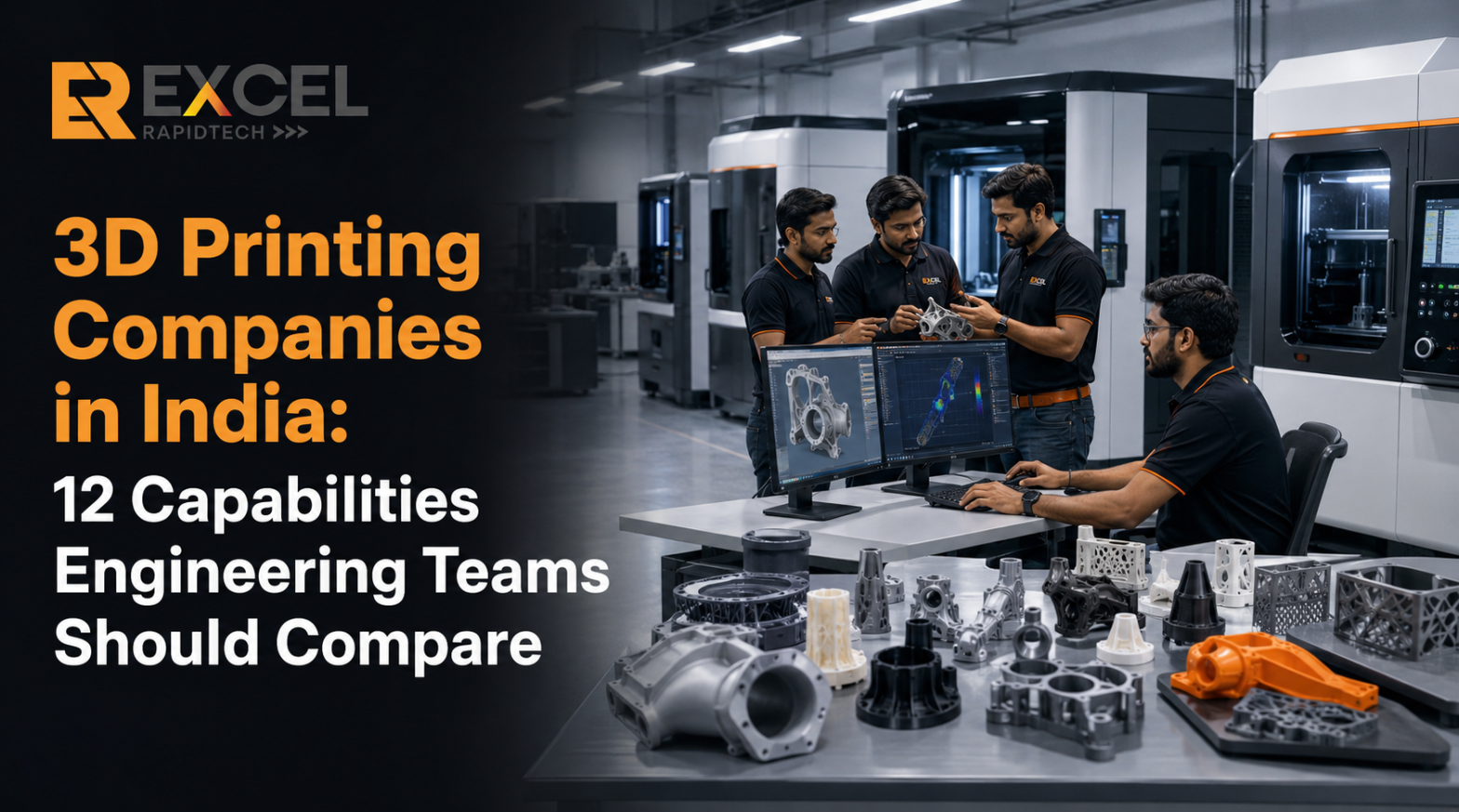
3d printing companies in india matters because not every 3D printing company plays the same role. Some suppliers mainly run machines, while stronger partners add CAD review, process advice, finishing, inspection, and commercial guidance that keeps the project from stalling after the first quote.
The search for 3d printing companies in india normally starts when a team has a model in hand and needs a practical answer, not a generic brochure.
This article is built around that real decision. It explains what matters first, where the common mistakes show up, and how to move toward a clean technical discussion with a supplier.
Start with the part, not the machine
The safest way to evaluate 3d printing companies in india is to start with the part, not the process name. Ask what the part must prove. Does it need to look right, fit correctly, survive handling, carry load, or support a pilot quantity? Once that is clear, the process shortlist gets much tighter.
The next checkpoint is tolerance and finish. A supplier should ask which surfaces matter, which interfaces are critical, and whether cosmetic post-processing is acceptable. That discussion is more useful than generic language about ‘high quality’ because it defines the acceptance criteria before production starts.
Commercial discipline matters too. A cheap quote on the wrong process is not a saving. Neither is a fast promise that ignores finishing, inspection, inserts, packing, or shipping. A stronger supplier will separate those assumptions so the team can see where risk is hiding.
The criteria that actually matter
- Look for evidence that the supplier can review the design, not just print whatever arrives
- Ask the supplier to recommend the process in writing and explain the trade-off behind that recommendation
- Confirm whether the material choice is cosmetic, functional, or intended to mimic a later production polymer
- State which dimensions and interfaces are critical so the build is reviewed against real acceptance criteria
- Clarify what finishing is included, what is optional, and what finish level the images in the quote actually represent
- Check whether inspection, inserts, assembly, painting, and shipping are included or treated as extras
- Confirm how revisions are handled if the CAD file changes after the first review
How the main process options fit
A capable supplier should explain its process coverage in plain terms. If the part needs cosmetic quality, the answer may point to SLA or DLP. If it needs better mechanical behaviour and freedom from support scars, SLS or MJF may be a better fit. If the team wants multiple plastic parts that look close to production pieces, vacuum casting may be the smarter route.
Coverage alone is not enough. The supplier should also explain where each route stops being sensible. That honesty is a useful quality signal because it shows the recommendation is tied to the part, not just to the easiest machine to sell.
Support services matter too. Finishing, insert installation, sanding, painting, simple assembly, inspection, and design feedback often make the difference between a technically printable part and a genuinely useful one.
What to send before you ask for a quote
- A clean CAD file in STEP, IGES, STL, or the format your supplier prefers
- The quantity split, including whether you need one part, a short batch, or staged deliveries
- The material expectation, especially if the part needs heat, impact, chemical, or cosmetic performance
- Critical tolerances, assembly interfaces, and any surfaces that cannot be reworked freely
- Post-processing needs such as sanding, painting, vapour smoothing, inserts, threading, or inspection
- The real delivery date, destination, and whether design feedback is welcome before production starts
Common mistakes during supplier selection
- Choosing the process by habit instead of by part function
- Sending a file without naming the critical surfaces, tolerances, and finish expectations
- Asking for a rush quote before the quantity and delivery address are clear
- Treating post-processing as an afterthought even when appearance matters
- Skipping the discussion about how the prototype result will influence the next manufacturing step
Limits to keep in view
A supplier can own good machines and still be a weak fit if CAD review, communication, inspection, or confidentiality are not handled well.
Frequently asked questions
What should I compare before choosing a supplier?
Compare process fit, material range, design-review depth, finish quality, inspection discipline, communication quality, and how clearly the commercial assumptions are written down.
How many suppliers should I shortlist?
Two or three solid comparisons are usually enough if the briefs are clear. More than that often adds noise unless the project is unusually sensitive or the capability is rare.
What if I am unsure which process fits the part?
That uncertainty is normal. A good supplier should be able to explain the leading options, the trade-offs behind them, and why one route is being recommended for your specific geometry and quantity.
Should I ask for design feedback before placing the order?
Yes. Early feedback often saves more time than a rushed build. It can catch thin walls, weak bosses, unrealistic finish expectations, and tolerance issues before the job becomes expensive.
Recent Insights
-
What is the Vacuum casting process? Step-by-Step Explanation January 28, 2026
-
End-to-End 3D Printing Services for Engineers and Manufacturers February 17, 2026
-
Which 3D Printing Technology Should You Choose? A Guide for Engineers February 20, 2026
-
3D Printing Services in India: Complete Guide to Technologies, Materials and Applications July 14, 2026
-
How to Choose 3D Printing Services in India for Industrial Prototypes July 14, 2026
-
3D Printing Services in India: SLA vs SLS vs MJF vs DLP July 14, 2026
-
3D Printing Services in India: Cost, Lead Time and RFQ Checklist July 14, 2026
-
What Does a Professional 3D Printing Service Include? From CAD Review to Finishing July 14, 2026
-
In-House 3D Printing vs a Professional 3D Printing Service: Which Is Better? July 14, 2026
-
How a 3D Printing Service Supports Product Development and Low-Volume Production July 14, 2026
-
3D Printing Service Cost Guide: Materials, Quantity, Finish and Lead Time July 14, 2026
-
What Do 3D Printing Companies Do? Services, Processes and Industries Explained July 14, 2026
-
3D Printing Companies in India: 12 Capabilities Engineering Teams Should Compare July 14, 2026