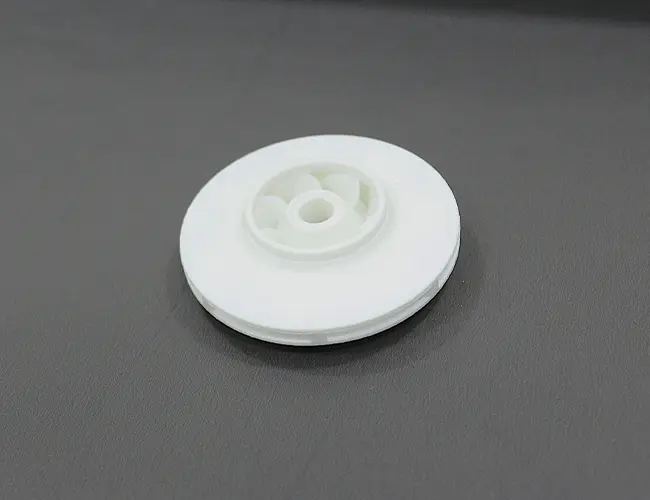
About SLS
Selective Laser Sintering (SLS) is a type of powder bed fusion, one of the oldest and most respected 3D printing technologies.
In this process, a thin layer of polymer powder is placed over the build platform and a CO2 laser traces the cross section of the parts to be manufactured, on the powder layer. Then the powder is fused together at high temperature. The platform is then lowered one layer and the process continues. This process is repeated until the complete part is built.
This is an industrial 3D printing technology that produces accurate, functional parts that are used in almost every industry.
Primarily, this process uses nylon material, although other material options do exist.
SLS 3D printing is extremely appealing to designers, engineers, and industrial companies of all sizes.
Advantages of SLS
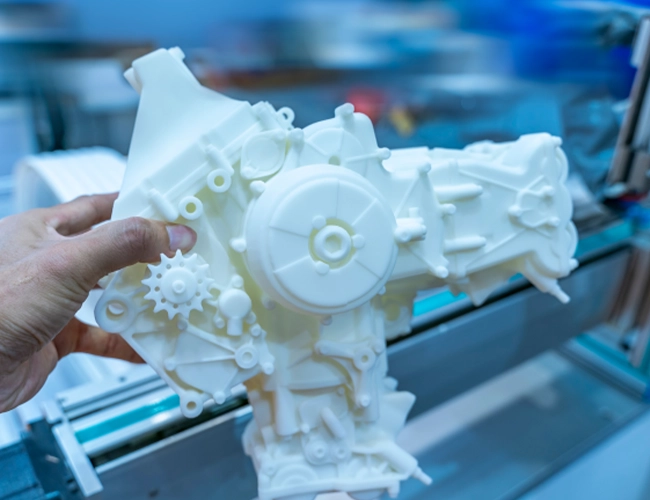
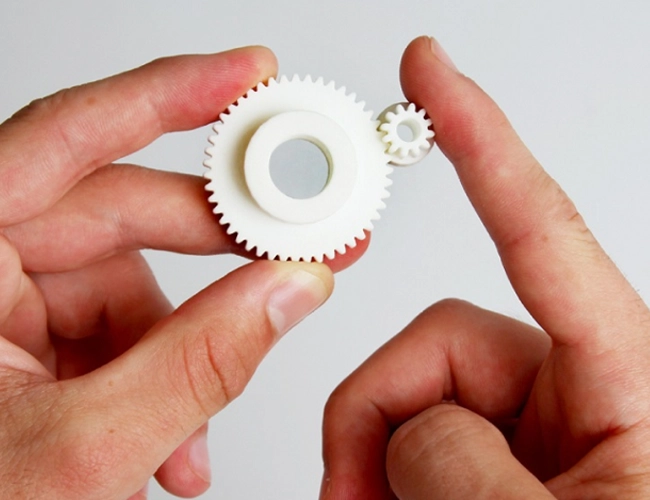
SLS is an excellent technology to manufacture complex structures. SLS can be used to manufacture parts that have moving or interlocking structures and is a versatile choice for industrial use parts, be it prototypes, end use parts or jigs & fixtures.
This technology can be used to manufacture structures that were previously impossible via traditional manufacturing methods or even via other 3D printing technologies. It is possible to manufacture hundreds or even thousands of parts at once, as long as the parts fit inside the build space.
Perfect technology for high volume, functional and repeatable parts.
- Nylon offers durability, strength and resistance.
- Parts can be shipped in as low as 1-2 days, speeding up the design to market process.
- End use parts can be made faster than ever before.
- Allows for complex geometry.
- Multiple parts can be manufactured at once.
- High precision parts having low tolerances.
When to choose SLS
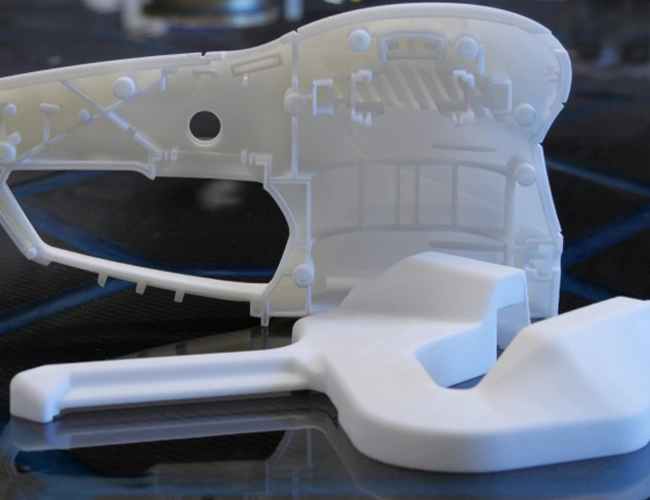
SLS is perfect when you need prototypes or functional end use parts that have good mechanical properties like durability, strength and resistance to environmental factors. Nylon material, while flexible and resistant to breakage, offers these coveted qualities.
Parts with fitments, locking mechanisms, moving parts, etc. can be perfectly made.
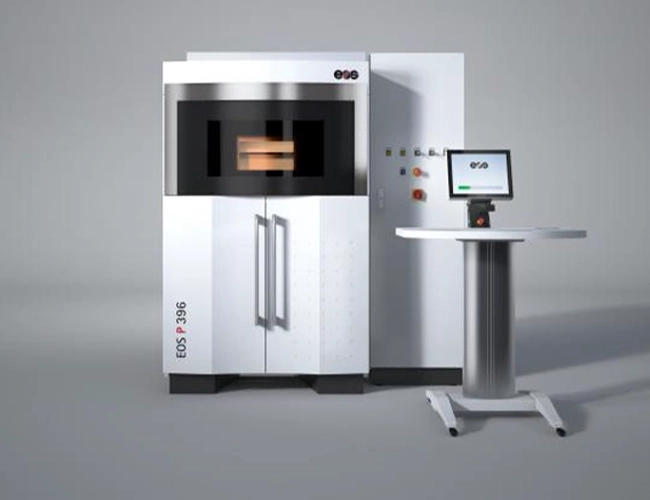
Machine Details
- Make: EOS (Germany)
- Model: P396E
- Build Size: 340 x 340 x 600mm
- Print Layer Thickness: 120 um
Material Details
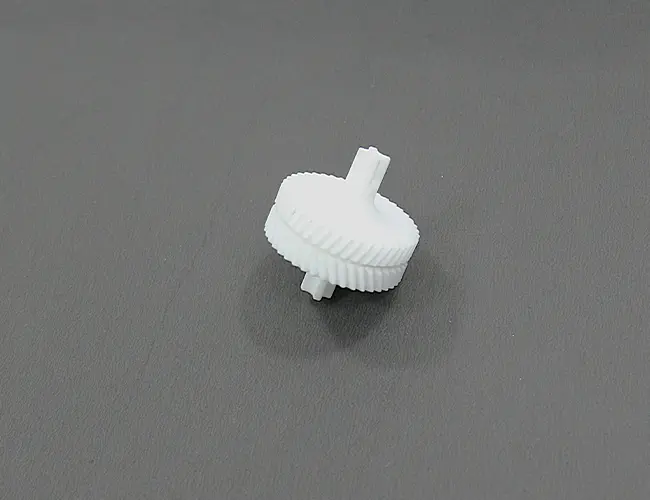
PA-12 Nylon
Nylon 12 is a strong, multipurpose material renowned for its use in industrial products.
- Applications: General manufacturing for prototypes, jigs & fixtures, end use parts.
- Typical part properties:
- Tensile modulus: 1650 MPa
- Tensile strength: 48 MPa
- Nominal strain at break: 18%
- Deflection temperature @ 0.45 MPa: 157 deg C
- Density: 0.93 g/cm3
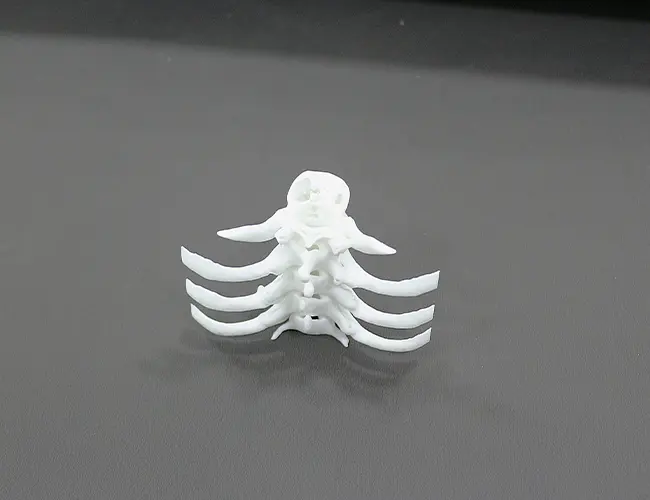
PA-12 30% Glass Filled Nylon
Highly rigid parts with high abrasion resistance.
- Applications: Machine components, heavily used parts, forming tools, etc.
- Typical part properties:
- Tensile modulus: 3200 MPa
- Tensile strength: 51 MPa
- Nominal strain at break: 9%
- Deflection temperature @ 0.45 MPa: 157 deg C
- Density: 1.22 g/cm3
PA-11 Nylon (Black)
Parts manufactured using PA-11 have high impact resistance and elongation at break. Parts do not splinter even at high mechanical loads.
- Applications: Impact resistant, functional parts
- Typical part properties:
- Tensile modulus: 1560 MPa
- Tensile strength: 48 MPa
- Nominal strain at break: 30%
- Density: 0.99 g/cm3