In-House 3D Printing vs a Professional 3D Printing Service: Which Is Better?
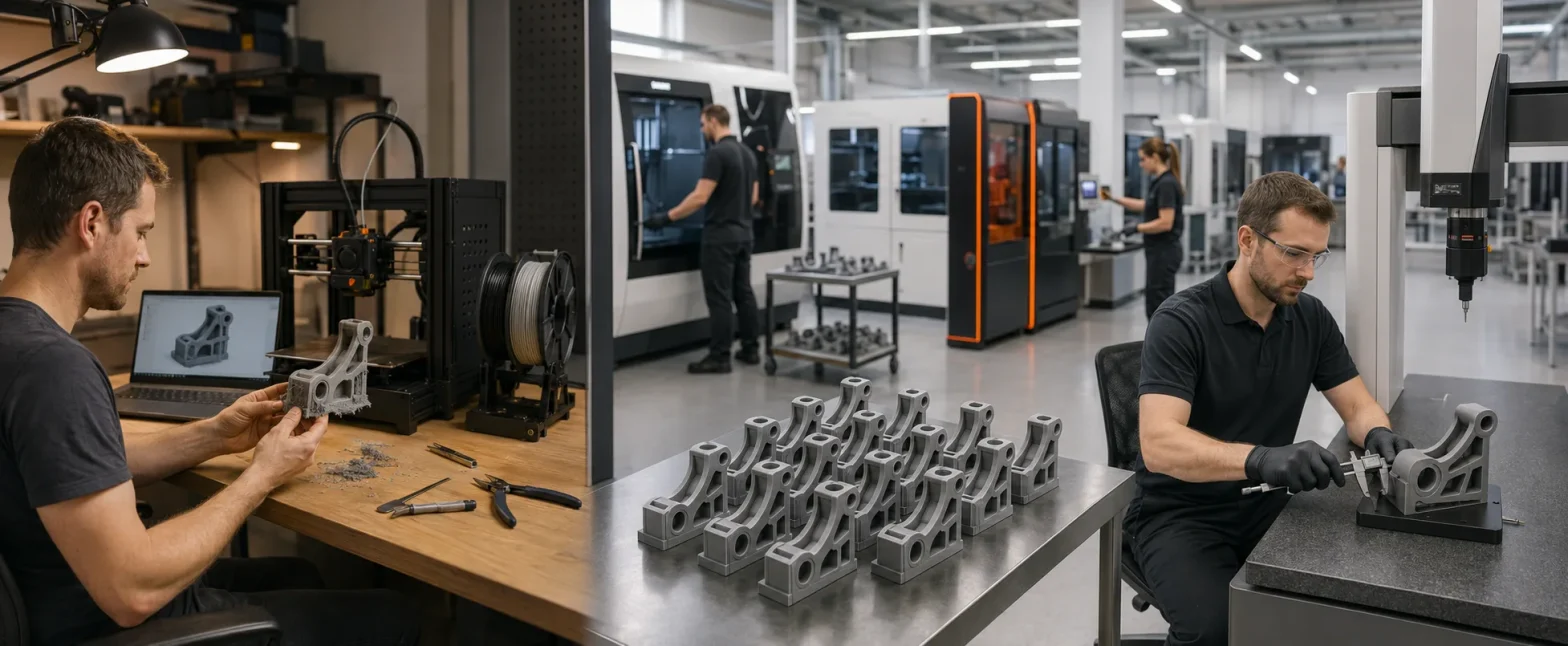
Quick answer: In-house 3D printing is usually the better choice for frequent, low-risk iterations that use the same process, material and quality level. A professional 3D printing service is generally the stronger option when the project needs multiple technologies, engineering-grade materials, tighter tolerances, specialist finishing, inspection or reliable delivery for a customer or production decision. The correct comparison is not printer price versus quotation price. It is total project cost, including people, failed builds, maintenance, downtime and the cost of choosing the wrong process.
A desktop or entry-level FDM printer can be useful for early form checks, packaging studies, fixture concepts and quick internal discussions. It does not automatically replace industrial additive manufacturing. Once a part must survive load, present a specific surface, fit an assembly, support testing or influence tooling, the decision becomes less about owning a machine and more about controlling technical risk.
The decision at a glance
| Decision factor | In-house 3D printing | Professional 3D printing service |
| Best use | Repeated, similar, low-risk parts | Mixed requirements and higher-risk projects |
| Technology access | Limited to owned machines | Access to SLA, SLS, MJF, DLP, FDM, metal and related routes |
| Speed | Fast when the machine and operator are free | Fast when the job is routed to the correct process and capacity |
| Quality control | Depends on operator skill and internal inspection | Can include engineering review, finishing and inspection |
| Cost exposure | Capital cost plus labour, failures, maintenance and idle time | Quoted project cost plus any agreed finishing or inspection |
| Scalability | Bound by machine and operator capacity | Better suited to batches, staged quantities and process changes |
When in-house 3D printing makes sense
An internal printer can earn its place when demand is steady and the jobs are predictable. A product team that repeatedly prints the same class of brackets, ergonomic mock-ups, assembly aids or low-risk concept models may benefit from immediate access. Designers can check scale, clearances and handling without waiting for an external quotation or delivery slot.
The strongest in-house case has four characteristics: the team knows exactly what the printer can and cannot do, most jobs use the same material family, the required finish is modest, and trained people are available to prepare files, operate the machine and maintain it. In this situation, ownership can shorten iteration cycles because the work fits the installed capability rather than forcing the machine to handle every possible application.
In-house printing also makes sense when confidentiality or rapid experimentation matters and the parts are not being used to approve tooling, validate a load case or represent final production quality. A rough FDM model can answer a simple question quickly: Does the shape fit? Is the handle comfortable? Can the electronics package fit inside the enclosure? For such questions, speed can matter more than surface finish or exact material behaviour.
Where in-house printing is often overestimated
The presence of a printer can create false confidence. Teams sometimes start designing around the machine they own rather than the part they need. An FDM printer may produce a visible object quickly, but layer direction, porosity, anisotropy, support marks and limited material choice can make that object a poor basis for engineering conclusions. A concept model may look complete while still being unsuitable for functional testing.
Industrial 3D printing also requires more than the machine itself. File preparation, build orientation, support strategy, process parameters, material storage, calibration, post-processing, extraction, cleaning, finishing, inspection and documentation all affect the result. Some processes require controlled environments, dedicated equipment and trained operators. A machine that is rarely used can be expensive. A machine that is heavily used without proper process control can be even more expensive because it produces unreliable evidence.
When a professional 3D printing service is the better route
Outsourcing becomes more attractive when the application changes from job to job. A cosmetic presentation model may need SLA. A functional nylon housing may suit SLS or MJF. A small set of production-like samples may be better produced through vacuum casting. A metal component may require an entirely different manufacturing route. No single printer, material or post-processing setup covers all of these needs well.
A specialist provider can review the CAD file, intended use, quantity, tolerance, surface requirement and project deadline before recommending a route. This process guidance is often more valuable than the print itself. Excel Rapid Tech’s professional 3D printing services page shows the range of additive processes available for projects that cannot be solved by one desktop machine or one material family.
A professional service is especially useful when the part will be shown to a customer, used in functional validation, evaluated for assembly, photographed for marketing, supplied in a small batch or used to guide production planning. In these cases, the cost of a late delivery or an incorrect process choice may exceed the quoted printing cost many times over.
Compare total project cost, not machine price
The purchase price of a printer is only the visible part of in-house cost. A fair comparison should include the machine, installation, software, operator time, training, consumables, material waste, support removal, finishing, inspection tools, maintenance contracts, spare parts, failed builds, energy, floor space and downtime. It should also account for idle capacity when demand is irregular.
The biggest hidden cost is often the wrong decision. A part printed in an unsuitable material may pass a visual review but fail during use. A surface produced by the wrong process may lead a customer to reject a design that would look acceptable through a different route. A distorted prototype may send an engineer back to CAD even though the design was correct. These errors consume time across design, purchasing, management and production, not just the printing budget.
Hidden-cost checklist
| Cost area | Typical in-house exposure | What outsourcing can make visible |
| People | File preparation, monitoring, finishing, troubleshooting | Defined scope, review and delivery responsibilities |
| Failures | Material waste, lost machine time, repeat labour | Reprint responsibility depends on the agreed specification |
| Maintenance | Calibration, parts, service contracts, downtime | Included within supplier capability and quotation structure |
| Quality | Internal measurement and process knowledge required | Inspection and finishing can be specified before ordering |
| Wrong process | Risk of a misleading prototype or wrong decision | Access to process selection guidance before production |
Speed depends on more than print time
An internal printer can be faster for a simple overnight concept model when the machine is available and the file needs little preparation. That advantage disappears when the build fails, the machine is occupied, the part needs specialist finishing or the internal team spends several days learning a new material. Print time is only one part of lead time.
A professional service may take longer to quote and schedule, but it can shorten the full decision cycle by selecting the correct technology, running the build under established conditions and completing post-processing in parallel. For urgent commercial work, predictable delivery is often more useful than the shortest theoretical machine time.
Quality, accuracy and finishing
Quality should be defined against the application. A rough enclosure mock-up may only need dimensional plausibility. A snap-fit, airflow component, medical model, customer sample or assembly fixture may need controlled dimensions, material behaviour or a specific cosmetic finish. Using the same quality standard for every prototype wastes money, but using a low standard for a critical part creates risk.
Professional suppliers can combine printing with sanding, painting, dyeing, polishing, support removal, machining, inserts, assembly and inspection where required. The available industrial 3D printing infrastructure is relevant when a project needs controlled production rather than a machine-only output.
Use a hybrid model when possible
Many engineering teams do not need to choose one model forever. A hybrid approach is often the most efficient. Keep a simple internal printer for early shape checks, fixture ideas and rapid team discussions. Outsource parts that require engineering-grade materials, better finish, dimensional control, customer presentation, repeatable batches or process advice.
The handoff point should be defined before the project begins. For example, concept rounds one and two may be printed internally. The design can then move to a professional supplier for functional validation or a production-like sample. This keeps internal speed without asking a basic printer to support a decision it was never designed to support.
A practical decision framework
- Use in-house printing when the part is early-stage, low risk and clearly fits the process and material already available.
- Use a professional service when tolerance, surface finish, material behaviour, inspection or delivery reliability affects the decision.
- Outsource when the prototype may influence tooling, customer approval, certification, production planning or a commercial commitment.
- Compare the full project cost, not only the cost per gram, machine hour or printed piece.
- Ask whether the team needs a physical object or a manufacturing recommendation supported by process knowledge.
Why work with Excel Rapid Tech for outsourced 3D printing?
This comparison becomes relevant when a project has moved beyond a basic visual model and the team needs help choosing the correct route. Excel Rapid Tech brings multiple additive manufacturing technologies, post-processing support and related low-volume manufacturing options into one workflow. That matters because the best answer may be SLA, SLS, MJF, DLP, FDM, metal printing, vacuum casting or a combination of processes rather than a single default technology.
Teams can review the broader 3D printing technology selection guide before finalising a process. Projects that need multiple production-like samples can also evaluate vacuum casting instead of assuming direct 3D printing is always the final answer.
The value of a professional partner is not a generic promise of better quality. It is the ability to connect intended use, material, process, finishing, quantity and inspection in one recommendation. That gives engineers and buyers a clearer basis for comparing cost and risk before the part is produced.
What information should you send for an accurate quotation?
A useful request for quotation should include the 3D CAD file, part quantity, intended use, preferred material if known, critical dimensions, finish expectation, colour, delivery location and required date. State whether the part is for a visual review, fit check, functional test, customer presentation or low-volume use. This context allows the supplier to recommend a process rather than merely price the first printable option.
For a project-specific comparison, request a 3D printing quotation and share the part file with the expected use case. The quotation should make clear what process, material, finishing and inspection are included.
Frequently asked questions
Is in-house 3D printing cheaper than outsourcing?
It can be cheaper for frequent, simple and low-risk parts when the team already has the right machine, trained operators and predictable demand. The comparison changes once labour, failures, maintenance, finishing, inspection and idle capacity are included.
What is the biggest advantage of a professional 3D printing service?
The main advantage is access to multiple processes and experienced application review. This reduces the chance of choosing a material or technology that produces a fast part but an unreliable engineering or commercial conclusion.
Can an in-house FDM printer replace an industrial 3D printing service?
It can replace outsourced work for the limited range of parts that suit its build size, material, accuracy and finish. It cannot replace processes such as SLA, SLS, MJF or metal printing, nor can it automatically provide specialist finishing, inspection or manufacturing advice.
When should a company buy an industrial 3D printer?
Ownership becomes easier to justify when demand is steady, the process requirement is narrow, utilisation can be measured, trained staff are available and the business can support maintenance, post-processing and quality control.
Is a hybrid model practical?
Yes. Many teams use an internal printer for early concept checks and outsource parts used for functional testing, customer approval, low-volume batches or production decisions.
What should be compared before deciding?
Compare workload consistency, technology range, material requirements, operator time, finishing, inspection, lead time, machine utilisation, failure risk and the cost of making a wrong design or production decision.
Final decision
In-house 3D printing and professional services solve different problems. Internal printing is strongest when speed, convenience and repeated low-risk iterations matter. Outsourcing is stronger when the part needs a process the company does not own, a material it cannot control, a finish it cannot reproduce or a result that will influence a serious business decision.
The better option is the one that answers the project question with the lowest total risk. A cheap print that produces the wrong conclusion is expensive. A well-specified outsourced part may cost more per piece but save time across engineering, customer approval and production planning.
Recent Insights
-
What is the Vacuum casting process? Step-by-Step Explanation January 28, 2026
-
End-to-End 3D Printing Services for Engineers and Manufacturers February 17, 2026
-
Which 3D Printing Technology Should You Choose? A Guide for Engineers February 20, 2026
-
3D Printing Services in India: Complete Guide to Technologies, Materials and Applications July 14, 2026
-
3D Printing Services in India: SLA vs SLS vs MJF vs DLP July 14, 2026
-
3D Printing Services in India: Cost, Lead Time and RFQ Checklist July 14, 2026
-
In-House 3D Printing vs a Professional 3D Printing Service: Which Is Better? July 29, 2026